
Direct fired (natural gas / diesel)
A built-in burner supplies the heat. Suits sites with a gas or diesel supply where electricity is expensive or grid capacity is limited.
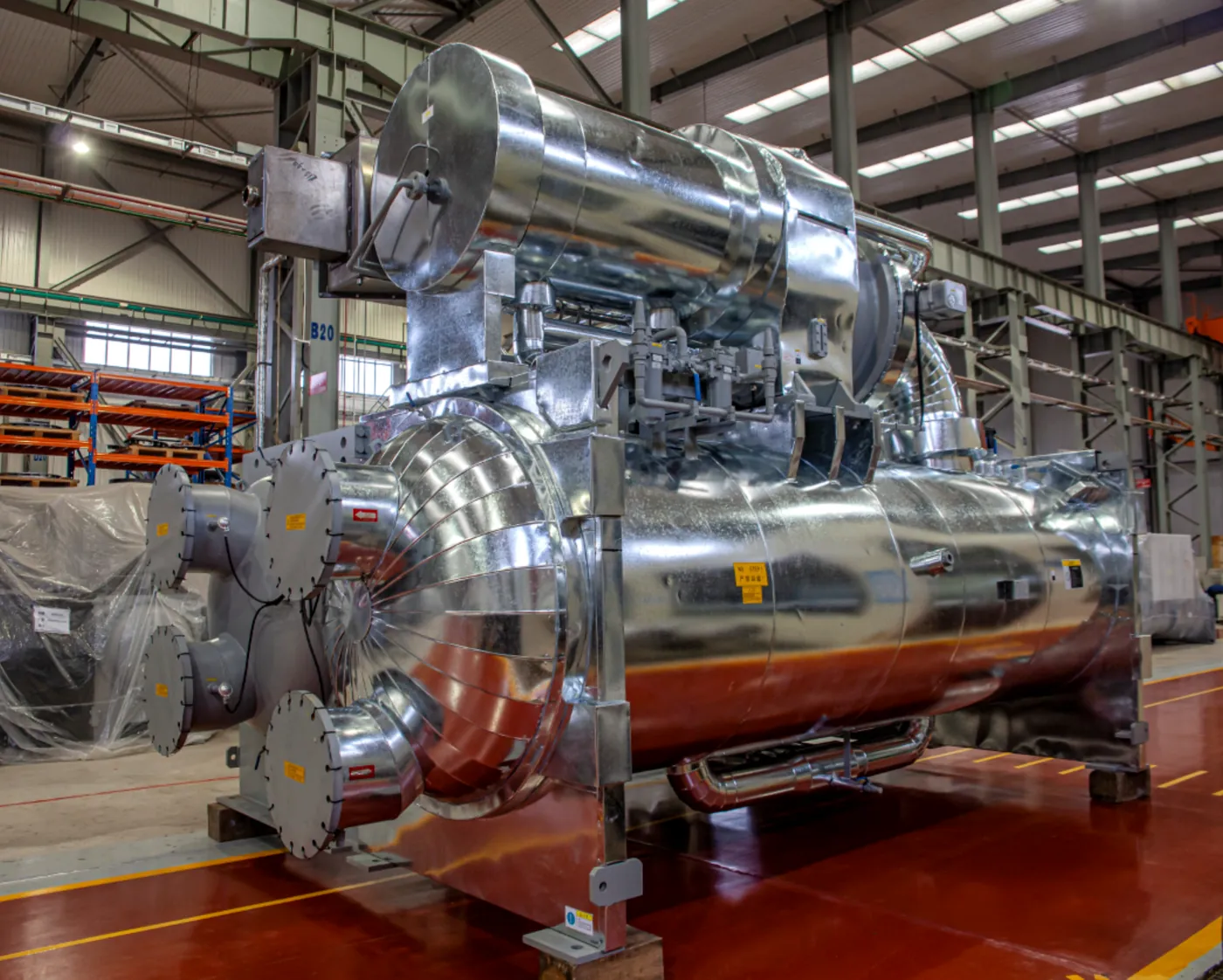
Ebara absorption chillers
Chilled water made from heat instead of electricity. Ebara absorption chillers from 100 – 3,500 RT run on steam, hot water, gas or engine waste heat, supplied, installed and serviced across Pakistan by MA Engineering.
The basics
An absorption chiller produces chilled water for air conditioning or process cooling, just like an electric chiller. The difference is what drives it: instead of a large electric compressor, it runs on heat. That can be steam, hot water, a gas or diesel burner, or the exhaust of an engine.
Inside, water is the refrigerant and a lithium bromide salt solution does the work of the compressor. The only motors are small pumps, so the chiller uses a small fraction of the electricity of an equivalent electric machine, runs quietly with very little vibration, and needs no CFC or HFC refrigerants.
For factories, hospitals and hotels that already have heat to spare, or that pay heavily for every kilowatt-hour, an absorption chiller can turn a large running cost into a small one.
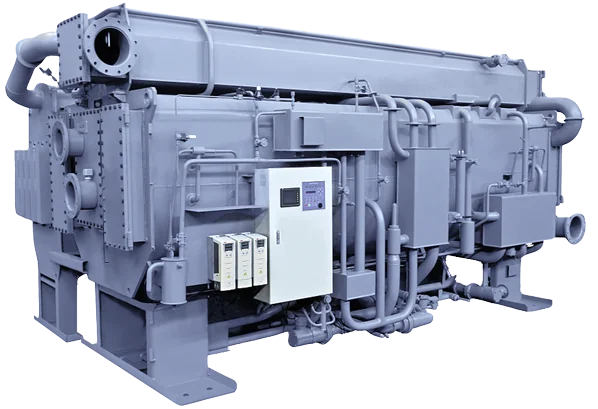
How it works
Water is the refrigerant, lithium bromide is the absorbent, and heat is the fuel. Here is what happens inside the machine.
Under a deep vacuum, water evaporates at only about 4 °C. As it evaporates it draws heat out of the chilled-water circuit that cools your building or process.
A concentrated lithium bromide solution soaks up that water vapour, which keeps the pressure low so evaporation can continue. The heat released here goes to the cooling tower.
A small pump sends the diluted solution to the generator, where your heat source boils the water back out of it. This step replaces the electric compressor.
The water vapour condenses on tubes cooled by cooling-tower water and returns to the evaporator. The re-concentrated solution flows back to the absorber, and the cycle repeats.
Double-effect machines add a second, high-temperature generator that uses the same heat twice. They need a hotter heat source but produce almost twice as much cooling from each unit of heat.
Heat sources
Ebara builds absorption chillers for every common heat source. The right model depends on the temperature and quantity of heat available at your site.
A built-in burner supplies the heat. Suits sites with a gas or diesel supply where electricity is expensive or grid capacity is limited.
Runs on boiler or process steam. Single-effect models use low-pressure steam of about 1 bar(g); double-effect models use around 8 bar(g) for higher efficiency.
Uses hot water at roughly 90–115 °C, such as engine jacket water or process hot water that would otherwise be cooled and wasted.
Combines several heat sources, for example exhaust gas and jacket water from the same engine, to get the most cooling from the heat available.
Hydrogen-fuelled models for sites that are planning a move to low-carbon fuels.
Recovers low-grade heat to produce cooling or heating, depending on what the site needs at the time.
Single vs double effect
Single-effect machines work with lower temperature heat. Double-effect machines need hotter heat but are far more efficient.
| Property | Single effect | Double effect |
|---|---|---|
| Heat source needed | Hot water about 90–115 °C, or low-pressure steam about 1 bar(g) | Steam about 8 bar(g), hot water about 175 °C, gas firing or hot exhaust |
| Typical efficiency (COP) | 0.70 – 0.80 | 1.35 – 1.42 |
| Cooling from each unit of heat | Baseline | Almost double |
| Heat rejected to the cooling tower per kW of cooling | About 2.4 kW | About 1.75 kW |
| Best match | Engine jacket water, low-pressure steam, low-grade waste heat | Boiler steam, gas or diesel firing, turbine or engine exhaust |
Typical values for water/lithium bromide chillers, from the US Department of Energy fact sheet Absorption Chillers for CHP Systems. An electric chiller rejects about 1.2 kW per kW of cooling. Actual performance depends on the model and site conditions; we select the exact machine for your heat source.
Is it right for you?
A strong fit when…
Consider an electric chiller when…
We also supply high-efficiency electric chillers:
Why Ebara
Founded by Mr. Issey Hatakeyama in 1912, Ebara has manufactured fluid and HVAC machinery for more than 100 years to AHRI, JIS, ASME, ISO and CTI standards, with factories in Japan, China and Thailand under Japanese supervision.
Built into every Ebara absorption chiller
Planning a project
Getting these right at design stage is what makes an absorption plant pay back.
An absorption chiller sends about 1.75–2.4 kW of heat to the cooling tower for every kW of cooling, compared with about 1.2 kW for an electric chiller. The tower, condenser pumps and piping must be sized for it.
The temperature, pressure and flow of your steam, hot water or exhaust decide between single and double effect, and how much cooling you can get. We measure these before selecting a machine.
Scale and fouling in the condenser and absorber tubes quickly reduce output. A water-treatment programme for the cooling tower protects capacity and efficiency.
The machine runs under a deep vacuum. Regular checks of vacuum, solution condition and the purge system keep it efficient for many years. Ebara’s anti-crystallization and automatic dilution features protect it during shutdowns.
Efficiency stays nearly constant down to about half of full load, which suits plants whose cooling demand varies through the day.
Absorption chillers are larger and heavier than electric chillers of the same capacity. Plan the plant room, floor loading and rigging route early.
FAQ
Can’t find your answer? Ask our engineers.
It is a chiller that produces chilled water using heat instead of an electric compressor. Water is the refrigerant and lithium bromide is the absorbent. The heat can come from steam, hot water, a gas or diesel burner, or engine exhaust.
Very little. Electricity is only needed for the solution and refrigerant pumps and the controls, which is a small fraction of what an electric chiller of the same capacity consumes. The cooling tower fans and pumps are extra, as with any water-cooled chiller.
Single-effect chillers run on lower temperature heat, such as hot water around 90–115 °C or steam around 1 bar(g), with a typical COP of 0.7–0.8. Double-effect chillers need hotter heat, such as steam around 8 bar(g), direct firing or hot exhaust, but reach a COP of about 1.35–1.4, which means almost twice the cooling from the same heat.
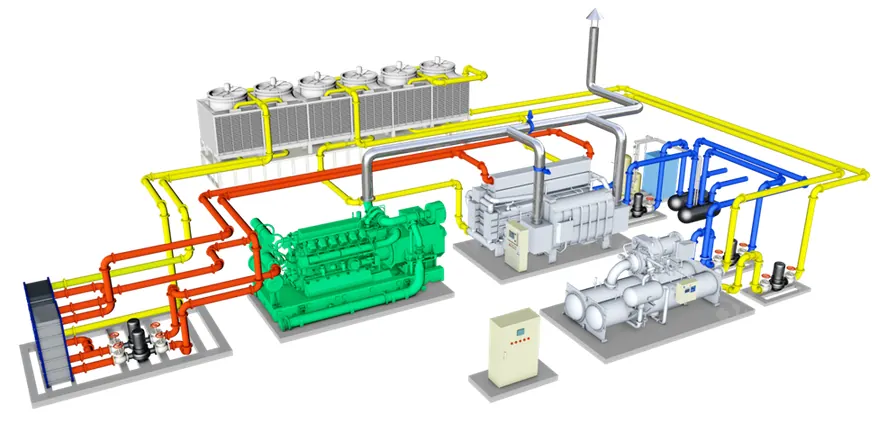
Yes. Engine exhaust gas, jacket water and process steam or hot water can all drive an absorption chiller. For sites with gas engines this is often called trigeneration: one fuel produces electricity, heat and cooling.
Yes. It rejects about 1.75–2.4 kW of heat for every kW of cooling, compared with about 1.2 kW for an electric chiller, so the cooling tower and condenser pumps are larger. We size them together with the chiller.
Water. The absorbent is a lithium bromide salt solution. There are no CFC, HCFC or HFC refrigerants, so there is no ozone depletion and no refrigerant phase-out to worry about.
Routine care includes checking vacuum tightness and the purge system, analysing the lithium bromide solution, cleaning condenser and absorber tubes, and treating the cooling-tower water. Our after-sales team provides this service.
Ebara absorption chillers are available from 100 – 3,500 RT. Several machines can be combined for larger plants or for standby capacity.
Get a selection
Send us your heat source details, such as steam pressure, hot-water temperature and flow, or engine model and load, along with your cooling requirement. Our engineers will propose the right Ebara chiller.
Related equipment