
Commercial buildings
Offices, hotels, hospitals and malls with cooling loads in the hundreds of tons.
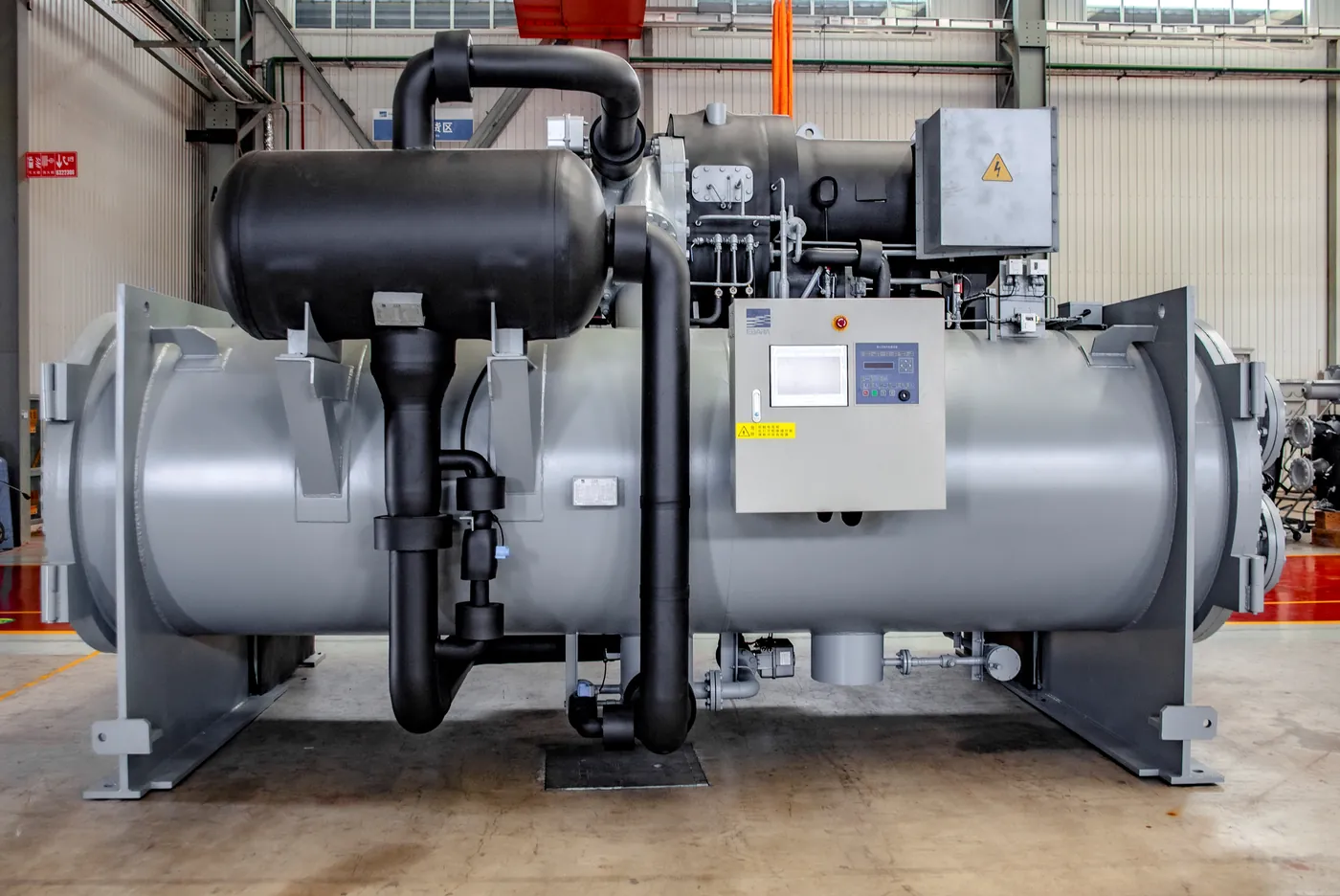
Ebara screw chillers
Reliable, efficient water-cooled chillers for commercial buildings and industry. Ebara screw chillers from 100 – 600 RT, with dual independent circuits and chilled fluid down to −20 °C.
The basics
A screw chiller is an electric water chiller built around a rotary screw compressor: two meshing helical rotors that trap refrigerant vapour and squeeze it into a smaller and smaller space as they turn. It is a positive-displacement machine, like a piston compressor, but with smooth, continuous rotation and few moving parts.
Screw compressors cope well with high pressure lifts and low loads. That makes them a strong choice for small and medium chilled-water plants, process cooling and low-temperature duties such as glycol or brine cooling.
Ebara screw chillers have two compressors, two condensers, two evaporators and two drives, arranged as independent circuits. If one side needs service, the other keeps cooling.

How it works
A screw chiller uses the standard refrigeration cycle. The screw compressor is what makes it robust and flexible.
Low-pressure refrigerant vapour from the evaporator enters the pockets between the two rotors.
As the rotors turn, each pocket shrinks and moves along the rotors, squeezing the vapour to high pressure.
The hot vapour condenses in the water-cooled condenser, handing its heat to the cooling-tower water.
The liquid expands to low pressure and boils in the flooded evaporator, chilling the water or glycol that serves your building or process.
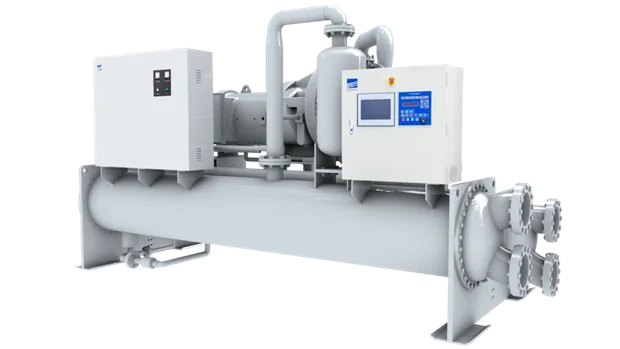
Capacity control: an inverter drive changes compressor speed to follow the load. That keeps efficiency high at part load and gives a smooth start without a large current spike.
Applications
Robust compressors and redundant circuits make screw chillers a dependable choice across buildings and industry.
Offices, hotels, hospitals and malls with cooling loads in the hundreds of tons.
Plastics, pharmaceuticals, food and chemicals, where chilled water must be available around the clock.
With glycol or brine, Ebara screw chillers deliver fluid as cold as −20 °C for cold storage and process applications.
Two independent circuits give built-in redundancy for hospitals, data rooms and continuous production.
Designed for plants that run day and night, with dual compressors sharing the duty.
Replacing older, less efficient chillers in existing plant rooms to cut energy use.
Screw vs centrifugal
Both are efficient water-cooled chillers. The deciding factors are size, load pattern and the water temperature you need.
| Property | Screw | Centrifugal |
|---|---|---|
| Compressor | Positive displacement: two meshing rotors | Dynamic: a high-speed impeller |
| Ebara capacity range | 100 – 600 RT | 150 – 3,200 RT |
| Best suited to | Small to medium plants, process cooling and high-lift duties | Large plants with high, steady loads |
| At low load | Handles low load and high lift comfortably | Needs good controls to avoid surge; variable speed helps |
| Lowest leaving fluid (Ebara) | −20 °C | −10 °C |
| US DOE (FEMP) full-load requirement, 300 tons and above | About 0.56–0.59 kW/ton | About 0.50–0.54 kW/ton |
Efficiency figures are the US Department of Energy FEMP purchasing requirements for water-cooled chillers (Path A, full-load optimised). Lower kW/ton is better; COP = 3.517 ÷ kW/ton.
Is it right for you?
A strong fit when…
Consider another type when…
Alternatives we supply:
Why Ebara
Founded by Mr. Issey Hatakeyama in 1912, Ebara has manufactured fluid and HVAC machinery for more than 100 years to AHRI, JIS, ASME, ISO and CTI standards, with factories in Japan, China and Thailand under Japanese supervision.
Built into Ebara screw chillers
Planning a project
Getting these right at design stage keeps the plant efficient and dependable for its whole life.
Accurate load calculations, and splitting capacity between two or more chillers, keep machines in their efficient range and provide standby.
For fluid temperatures near or below 0 °C, water needs glycol or brine. Its concentration affects pump and heat-exchanger sizing, so fix the leaving temperature early.
Condenser water temperature and tube cleanliness drive efficiency. Size the tower correctly and keep its water treated.
Inverter-driven compressors start smoothly, which reduces the starting current your transformer or generator must supply.
If the chiller will run mostly at part load, compare IPLV as well as full-load kW/ton. US DOE guidance separates chillers optimised for full load from those optimised for part load.
Regular oil and refrigerant analysis, tube cleaning and control checks keep a screw chiller efficient. Dual circuits let you service one side while the other keeps running.
FAQ
Can’t find your answer? Ask our engineers.
An electric water chiller that uses a rotary screw compressor, two meshing helical rotors, to compress refrigerant. It is robust, handles high pressure lifts and low loads well, and suits small to medium plants and process cooling.
Ebara water-cooled screw chillers range from 100 – 600 RT. Larger plants combine several chillers, which also provides standby capacity.
For large plants with steady loads, centrifugal chillers are usually the most efficient. For smaller plants, widely varying loads, high-lift conditions or low-temperature process cooling, screw chillers are often the better fit.
Ebara screw chillers can deliver leaving fluid from −20 °C to 35 °C. Below about 0 °C the circuit must use glycol or brine instead of plain water.
The chiller has two separate refrigerant circuits, each with its own compressor, condenser, evaporator and drive. If one circuit stops for a fault or service, the other keeps producing cooling.
It varies compressor speed to match the load, which improves part-load efficiency, and it starts the motor gently, avoiding the high current of a direct start.
Yes. It rejects heat through condenser water, usually from a cooling tower. We size and supply the towers, pumps and piping together with the chillers.
Periodic oil and refrigerant checks, condenser tube cleaning, inspection of electrical and control components, and cooling-tower water treatment. Our after-sales team provides this service.
Get a selection
Tell us your cooling load, required water temperature and operating hours. Our engineers will select the right Ebara screw chillers and size the cooling towers and pumps to match.