
Two-stage compressor
Compression in two stages with an economizer between them improves the cycle’s efficiency compared with a single stage.
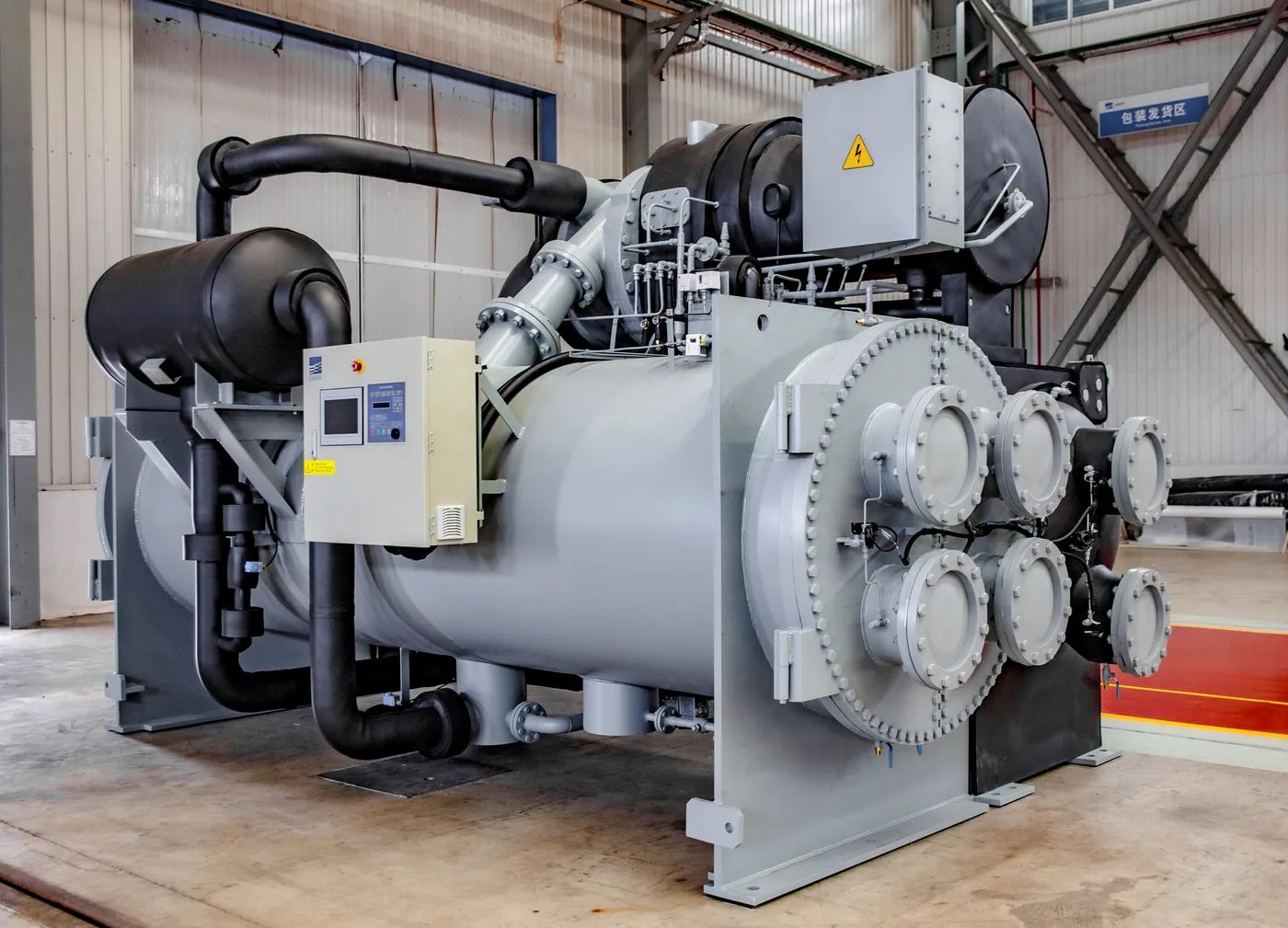
Ebara centrifugal chillers
The most efficient way to cool large buildings and plants. Ebara water-cooled centrifugal chillers from 150 – 3,200 RT, with Japanese-made two-stage compressors and a COP of 6.1 – 6.5.
The basics
A centrifugal chiller is an electric water chiller that compresses refrigerant with a high-speed impeller. Instead of squeezing gas in a closed chamber, the impeller flings refrigerant vapour outwards at high velocity and turns that speed into pressure.
One impeller can move a very large volume of vapour, so centrifugal machines dominate large chilled-water plants: office towers, hospitals, malls, hotels, airports and industrial process cooling. At these sizes they use the least electricity per ton of cooling of any common chiller type.
Ebara has built centrifugal chillers since 1929. Its current machines use two-stage compressors, inverter drives and servo-controlled inlet guide vanes to stay efficient from full load down to light load.

How it works
A centrifugal chiller uses the same four-step cycle as any electric chiller. What differs is the compressor.
Refrigerant boils at low pressure in the evaporator shell, taking heat from the chilled water flowing through its tubes. For air conditioning the water typically leaves at about 7 °C.
A high-speed impeller raises the pressure and temperature of the vapour. Two-stage compressors, as on Ebara machines, do this in two steps with an economizer between them for higher efficiency.
The hot vapour condenses on tubes cooled by water from the cooling tower, handing over the building’s heat plus the energy added by the compressor.
The liquid refrigerant passes through an expansion device, drops in pressure and temperature, and returns to the evaporator to start again.
Capacity control: inlet guide vanes and a variable-speed drive let the compressor follow the load. At very low load with high condenser pressure, a centrifugal compressor can reach surge, an unstable flow condition, so good controls keep it in its stable range.
Design options
Ebara centrifugal chillers are configured for each project. These are the options that matter most.
Compression in two stages with an economizer between them improves the cycle’s efficiency compared with a single stage.
A variable-speed drive lowers compressor speed at part load and removes the high inrush current of a direct motor start.
Leaving fluid from −10 °C to 35 °C covers comfort cooling, process cooling and, with glycol or brine, sub-zero duties.
Stainless steel, copper or titanium tubes to suit the condenser water quality, including harsh or saline water.
Zero ozone-depletion refrigerants with low global-warming potential.
Modbus and BACnet interfaces connect the chiller to your BMS, and variable primary flow compatibility can cut pumping energy.
Centrifugal vs screw
Both are efficient water-cooled chillers. The deciding factors are size, load pattern and the water temperature you need.
| Property | Centrifugal | Screw |
|---|---|---|
| Compressor | Dynamic: a high-speed impeller | Positive displacement: two meshing rotors |
| Ebara capacity range | 150 – 3,200 RT | 100 – 600 RT |
| Best suited to | Large plants with high, steady loads | Small to medium plants, process cooling and high-lift duties |
| At low load | Needs good controls to avoid surge; variable speed helps | Handles low load and high lift comfortably |
| Lowest leaving fluid (Ebara) | −10 °C | −20 °C |
| US DOE (FEMP) full-load requirement, 300 tons and above | About 0.50–0.54 kW/ton | About 0.56–0.59 kW/ton |
Efficiency figures are the US Department of Energy FEMP purchasing requirements for water-cooled chillers (Path A, full-load optimised). Lower kW/ton is better; COP = 3.517 ÷ kW/ton.
Is it right for you?
A strong fit when…
Consider another type when…
Alternatives we supply:
Why Ebara
Founded by Mr. Issey Hatakeyama in 1912, Ebara has manufactured fluid and HVAC machinery for more than 100 years to AHRI, JIS, ASME, ISO and CTI standards, with factories in Japan, China and Thailand under Japanese supervision.
Built into Ebara centrifugal chillers
Planning a project
A centrifugal chiller runs for decades. These decisions at design stage set its running cost for all of them.
US DOE guidance separates chillers optimised for full load from those optimised for part load (IPLV). Choose based on how many hours your plant really spends at each load.
An oversized chiller spends most of its life at low load, where efficiency falls and surge risk rises. Accurate load calculations and two or more chillers give better efficiency and standby.
Condenser water temperature has a large effect on efficiency. A correctly sized, well-maintained cooling tower and clean tubes keep kW/ton low.
Large chillers can need a dedicated transformer or medium-voltage motor. An inverter drive avoids the high starting current of a direct motor start.
Sequencing chillers, pumps and towers as one system saves more energy than any single machine. Variable primary flow can reduce pumping energy.
Annual inspections, tube cleaning, oil and refrigerant analysis and control calibration keep efficiency close to its day-one level.
FAQ
Can’t find your answer? Ask our engineers.
An electric water chiller that compresses refrigerant with a high-speed impeller. It is the most common choice for large chilled-water plants because it uses the least electricity per ton of cooling at large sizes.
Ebara water-cooled centrifugal chillers range from 150 – 3,200 RT. Larger plants use several chillers together, which also provides standby capacity.
Neither is better everywhere. Centrifugal chillers are usually the most efficient choice for large plants with steady loads. Screw chillers suit smaller plants, high-lift and low-temperature duties, and loads that vary widely.
Both measure efficiency. kW/ton is the electrical power needed per ton of refrigeration, so lower is better. COP is cooling output divided by power input, so higher is better. They convert as COP = 3.517 ÷ kW/ton: a COP of 6.1 equals about 0.58 kW/ton.
The Integrated Part Load Value is a weighted efficiency across 100%, 75%, 50% and 25% load, defined by AHRI Standard 550/590. Most chillers spend most of their hours at part load, so IPLV is often a better guide to running cost than full-load efficiency.
Surge is an unstable condition in which the compressor can no longer hold the pressure difference and the gas flow briefly reverses. It happens at low load combined with high condenser pressure. Guide vanes, variable-speed drives and good controls keep the chiller out of surge.
Ebara centrifugal chillers are water-cooled, so they reject heat through a cooling tower or another condenser water source. We size and supply the cooling towers together with the chillers.
Yes. Ebara centrifugal chillers offer Modbus and BACnet interfaces for full integration with a building management system.
Get a selection
Share your cooling load, operating hours and site details. Our engineers will size the plant and select the right Ebara chillers, cooling towers and controls.